

1-100 t/h (0.7-70 MW)
WNS Gas/Oil Steam Boiler, 1-100 t/h
Packaged three-pass wet-back fire-tube steam boiler for gas and oil, 1-100 t/h at 1.25 MPa, with matched modulating burner and ful...
View detailsThe WNS6-1.25-Q is a packaged three-pass wet-back fire-tube steam boiler rated at 6 t/h, 1.25 MPa and 194 °C, firing natural gas, LPG, light diesel or heavy fuel oil at 95% efficiency (LHV basis).
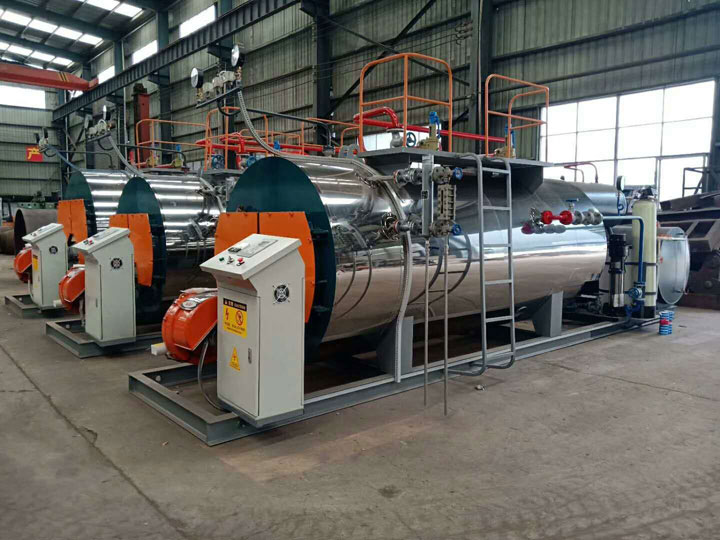
The WNS6-1.25-Q is a 6 t/h unit from the WNS gas/oil steam boiler series. It is a three-pass wet-back fire-tube boiler, factory-packaged with a low-NOx burner. Rated steam output is 6 t/h at 1.25 MPa and 194 °C saturated steam temperature. The boiler fires natural gas, LPG, light diesel or heavy fuel oil, and is rated at 95% efficiency on an LHV basis.
At 6 t/h, this unit sits in the mid-range of packaged fire-tube boilers. It suits plants with a steady process steam demand in the region of several tonnes per hour, plus modest peaks, where a single packaged unit can carry the base load without the footprint and staffing profile of a larger field-erected boiler. Typical duties include process heating, food and beverage operations, textile and chemical processing, and district or campus steam where demand is continuous but not large. The packaged format keeps site work to foundations, connections and commissioning.
The published fuel consumption is 446 Nm³/h at rated output, quoted for natural gas at 95% efficiency. The figure follows from the rated steam output and the fuel’s lower heating value: the heat required to raise 6 t/h of feedwater to 194 °C saturated steam is divided by the boiler efficiency, giving the fuel energy input, which is then converted to a volumetric flow using the gas LHV. Because the figure is tied to natural gas and 95% efficiency, consumption will differ with other fuels and with actual operating efficiency; LPG, light diesel and heavy fuel oil have different heating values and must be assessed on their own basis.
At 6 t/h the boiler is small enough that part-load operation is common, and the packaged fire-tube design responds well to it. The three-pass wet-back arrangement keeps the furnace and turnaround cooled and supports stable circulation across the load range. The low-NOx burner is matched to the boiler, and modulation lets output follow steam demand rather than cycling at full fire. Buyers should size the burner turndown to the plant’s minimum stable demand, since very low sustained loads affect efficiency and emissions performance.
The unit is delivered as a packaged assembly, so the installation envelope is essentially the boiler shell, burner and controls on a single base, plus the space needed for firing, access and maintenance. Site requirements are a suitable foundation, flue and fuel connections, feedwater and steam pipework, and clearance for burner service and tube access. No dimensions or weights are stated here; these must be confirmed against the model-specific general arrangement drawing before layout is fixed.
As with any fire-tube steam boiler, water treatment is essential to service life. Feedwater and boiler water should be controlled for hardness, dissolved oxygen, alkalinity and dissolved solids, with blowdown managed to keep concentration within limits. Scale and corrosion are the main threats to tube and shell integrity at this capacity, and a treatment programme matched to the local water analysis should be in place before commissioning.
The packaged unit is supplied with a burner management and boiler control system covering flame supervision, modulation against steam pressure, and safety interlocks. The low-NOx burner is integrated with the boiler controls so that firing rate, air/fuel ratio and safety functions operate as one system. Control scope and interface options should be confirmed against the project specification.
This size is chosen when demand is above what a smaller packaged unit can carry reliably but below the point where a larger boiler would run at poor part load. Moving down would leave little margin for peaks; moving up would add capacity the plant may not use, with the associated part-load penalty. The 6 t/h rating matches a base load that is steady and moderate.
| Parameter | Value |
|---|---|
| Model | WNS6-1.25-Q |
| Capacity | 6 t/h |
| Pressure | 1.25 MPa |
| Steam temperature | 194 °C |
| Feedwater temperature | Not stated in brief |
| Fuel | Natural gas, LPG, light diesel, heavy fuel oil |
| Fuel consumption at rated output | 446 Nm³/h (natural gas, 95% efficiency) |
| Efficiency | 95% (LHV basis) |
| Burner/control | Low-NOx burner, packaged with boiler controls |
| Application | Process steam, food and beverage, textile, chemical, district/campus steam |
It suits plants with a steady process steam demand of several tonnes per hour plus modest peaks, where one packaged unit can carry the base load. It is not intended for very large continuous demands that would require a bigger boiler.
It is derived from the heat needed to produce 6 t/h of 194 °C saturated steam at 1.25 MPa, divided by 95% efficiency (LHV basis), then converted to gas volume using the natural gas LHV. Other fuels have different heating values and must be assessed separately.
Yes. The three-pass wet-back design and matched low-NOx burner support modulated operation, so output can follow steam demand. Burner turndown should be matched to the plant's minimum stable demand, since very low sustained loads affect efficiency and emissions.
| Model | WNS6-1.25-Q |
|---|---|
| Capacity | 6 t/h |
| Pressure | 1.25 MPa |
| Steam temperature | 194 °C |
| Feedwater temperature | 20 °C (105 °C with deaerator) |
| Fuel | Natural gas, LPG, light diesel, heavy fuel oil |
| Fuel consumption at rated output | 446 Nm³/h (natural gas, 95% efficiency) |
| Efficiency | 95% (LHV basis) |
| Burner/control | Low-NOx burner, packaged with boiler controls |
| Application | Process steam, food and beverage, textile, chemical, district/campus steam |
1-100 t/h (0.7-70 MW)
Packaged three-pass wet-back fire-tube steam boiler for gas and oil, 1-100 t/h at 1.25 MPa, with matched modulating burner and ful...
View details1-10 t/h
A packaged WNS gas steam boiler with clean steam generator, sized 1-10 t/h at 1.0-1.25 MPa, for fermentation, granulation, sterili...
View details10 t/h
The WNS10-1.25-Q is a packaged three-pass wet-back fire-tube boiler delivering 10 t/h of steam at 1.25 MPa and 194 °C, firing natu...
View detailsExternal links open the publisher’s website and are provided for background reading.
Include the capacity (t/h or MW), fuel, working pressure and site country so the proposal matches your permit limits.
We appoint one or two partners per country to quote, deliver and service our boilers locally. Territory protection, factory pricing and commissioning support are part of the agreement.