
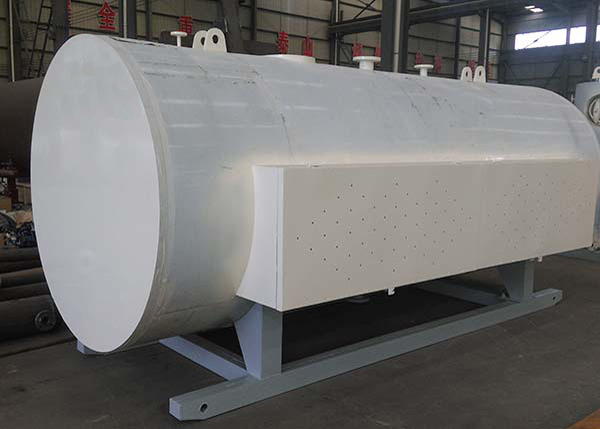
2 t/h
2 t/h Electric Steam Boiler WDR2-0.7
The WDR2-0.7 delivers 2 t/h of steam at 0.7 MPa and 170 °C from electric heating elements in a horizontal shell. Rated electric in...
View detailsAtmospheric drinking-water boiler, 30-500 kW, delivering 200-1,000 L/h of 100 °C boiled water for canteens, schools, hospitals and site camps.
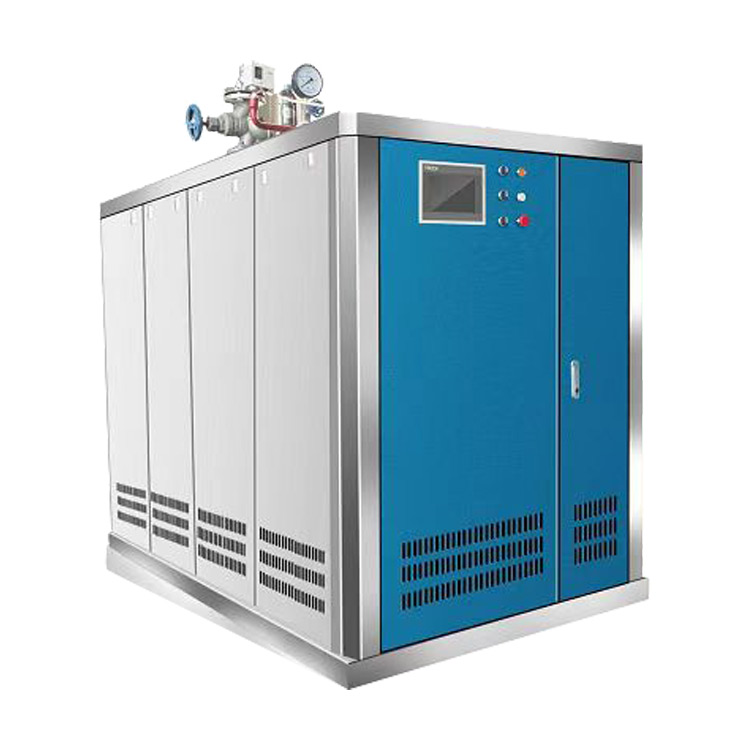
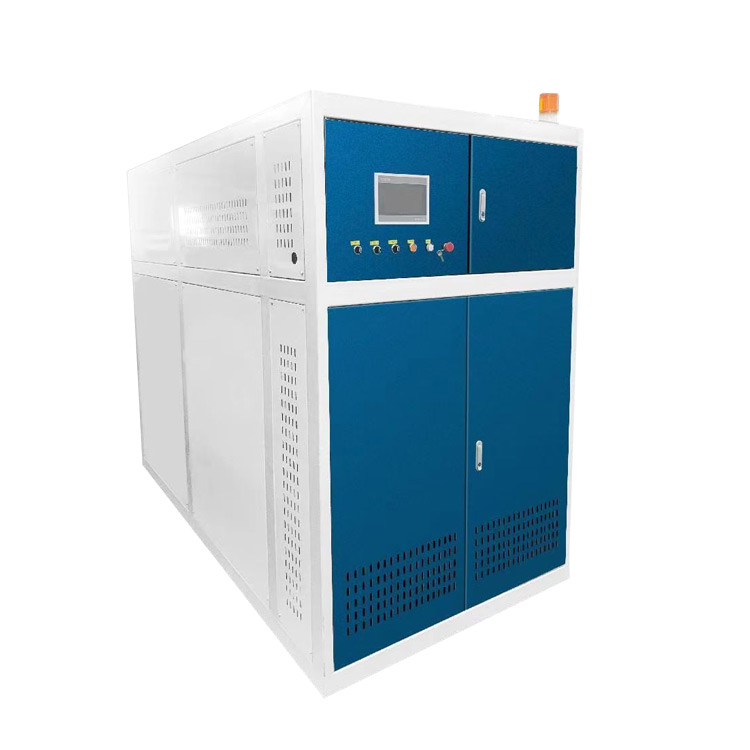
The CK series is a drinking-water boiler: a vessel of water heated to 100 °C at atmospheric pressure through an open vent, delivering 200 to 1,000 litres an hour of boiled water at the tap. It stands in factory canteens, school kitchens, hospital wards, construction camps and small hotels. It is not a steam boiler with a different set point, and the differences are what make it cheap to own.
Because the water sits at atmospheric pressure and 100 °C, there is no pressure boundary to certify, no steam space, no steam trap, no feedwater pump and no blowdown: just a tank, an element bundle, a level control, a thermostat and a tap. Water treatment stops at softening, and often at nothing, because the water leaves through a tap rather than being evaporated and concentrated.
A steam boiler holds pressure, controls level within tens of millimetres, treats feedwater to protect a heat flux of 60 to 100 kW/m², and blows down dissolved solids. A boiling water boiler does none of those. Its sheath runs at 110 to 120 °C against water at 100 °C, its heat flux is 20 to 40 kW/m², and its dissolved solids stay in the tank until someone drains it. The control system is a thermostat and a level switch. In most jurisdictions a vented unit at 100 °C falls outside pressure-vessel rules, but that is a local question worth confirming before a tender.
Scale is the whole maintenance story. A millimetre of calcium carbonate on a sheath has a thermal conductivity near 1 W/m·K against 15 for stainless steel, so the sheath temperature climbs 40 to 60 K at the same watt density. Element life roughly halves; at 1.5 mm the sheath runs hot enough to split, and the failure is a live element in a tank of drinking water.
The descale interval follows hardness, not the calendar. Below 1 mmol/L total hardness, once a year is enough and element life reaches 15,000 to 20,000 hours. At 2 to 3 mmol/L, descale every three to four months and expect 8,000 to 12,000 hours. Above 4 mmol/L, a softener is cheaper than elements; without one the interval falls to weeks and life to under 5,000 hours. Descaling is a citric or weak hydrochloric wash of the withdrawn bundle, two hours plus a rinse, with a new gasket each time.
The CK is a stored-water machine: a 200 to 1,000 litre tank held at 95 to 100 °C, with elements that reheat as water is drawn. Storage is what lets a 90 kW unit serve a canteen that empties the tank in twenty minutes. An instantaneous heater would need 200 kW for the same taps and no buffer when three open together.
Stored boiled water has a hygiene angle too. Holding the tank at 95 °C or above keeps it sterile, but the draw-off pipe cools between draws, so the outlet should be short, insulated and flushed daily. On a hospital or school unit, a weekly raise to 100 °C for thirty minutes is a cheap precaution.
A 1,000 litre tank insulated to 1.0 W/m²·K with 4.5 m² of surface loses about 315 W at 95 °C in a 25 °C room: 7.5 kWh a day, which cools the tank about 6 K. That is five minutes of element time, and it is why nobody switches these units off.
The physics is easy to check. Raising a litre from 10 to 100 °C takes 90 K times 4.186 kJ/kg·K, or 377 kJ, which is 0.105 kWh. A 500 L/h duty therefore needs 52 kW of continuous heat, and a 90 kW element set delivers 857 L/h running flat out.
The gap between 52 and 90 kW is peak capacity, not waste. A canteen draws 250 litres in the twenty minutes before service and 250 litres after: 500 litres in the hour, but at twice the average rate for part of it, and the tank must be back at temperature before the second wave. At 90 kW a 1,000 litre tank recovers 250 litres in about 17 minutes, allowing for standing loss; a 60 kW unit would still be recovering when the second wave arrived.
Electrically, 90 kW at 380 V three-phase draws 137 A: a 160 A breaker, a 4×35 mm² copper feed and roughly 100 kVA of spare transformer capacity. That last item is what stops projects, since a factory with a 250 kVA supply cannot add 90 kW without an upgrade that often costs more than the boiler.
No. It runs at atmospheric pressure through an open vent at 100 °C, so there is no pressure boundary to certify in most jurisdictions. That is also why it has no steam trap, no feedwater pump and no blowdown, and why the tank must never be valved shut on the vent.
By hardness, not by calendar: annually below 1 mmol/L, every three to four months at 2 to 3 mmol/L, and monthly above 4 mmol/L unless a softener is fitted. Scale of 1 mm roughly halves element life.
Not from the same tank. Boiled drinking water at 95 to 100 °C and 40 °C washing water are different duties with different hygiene rules; a second tank or a mixing station is the usual arrangement.
| Size class | 30 kW | 60 kW | 90 kW | 150 kW | 300 kW | 500 kW |
|---|---|---|---|---|---|---|
| Boiled water, continuous | 285 L/h | 570 L/h | 857 L/h | 1,430 L/h | 2,860 L/h | 4,760 L/h |
| Declared service output | 200 L/h | 350 L/h | 500 L/h | 800 L/h | 1,600 L/h | 2,700 L/h |
| Storage tank | 200 L | 300 L | 500 L | 1,000 L | 1,500 L | 2,000 L |
| Supply current at 380 V | 46 A | 91 A | 137 A | 228 A | 456 A | 760 A |
| Feed cable, copper | 4×10 mm² | 4×25 mm² | 4×35 mm² | 4×70 mm² | 2×4×95 mm² | 2×4×150 mm² |
2 t/h
The WDR2-0.7 delivers 2 t/h of steam at 0.7 MPa and 170 °C from electric heating elements in a horizontal shell. Rated electric in...
View details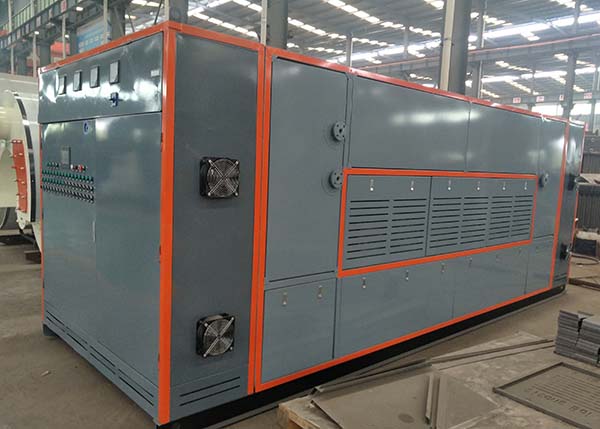
0.35-2.8 MW
Horizontal electric hot water boiler, 0.35-2.8 MW at 85/60 °C, for district heating, hospitals and process hot water without a flu...
View details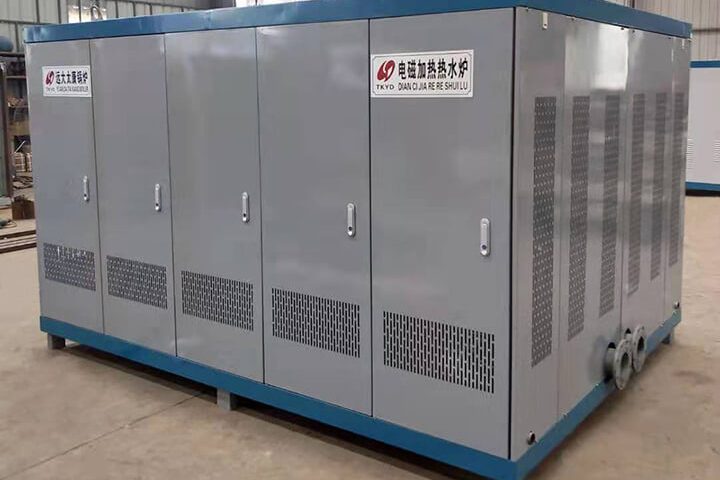
80, 90, 100 and 120 kW modules
Induction hot water boiler in 80-120 kW modules, 30-90 °C adjustable, for hotels, schools and clinics where a flue is impossible.
View detailsExternal links open the publisher’s website and are provided for background reading.
Include the capacity (t/h or MW), fuel, working pressure and site country so the proposal matches your permit limits.
We appoint one or two partners per country to quote, deliver and service our boilers locally. Territory protection, factory pricing and commissioning support are part of the agreement.