
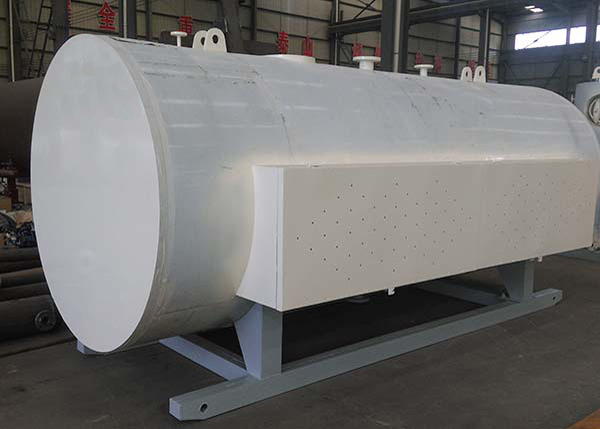
1 t/h
1 t/h Electric Steam Boiler WDR1-0.7
The WDR1-0.7 is a 1 t/h electric steam boiler producing 0.7 MPa steam at 170 °C. Heating elements sit in a horizontal shell with n...
View detailsInduction hot water boiler in 80-120 kW modules, 30-90 °C adjustable, for hotels, schools and clinics where a flue is impossible.
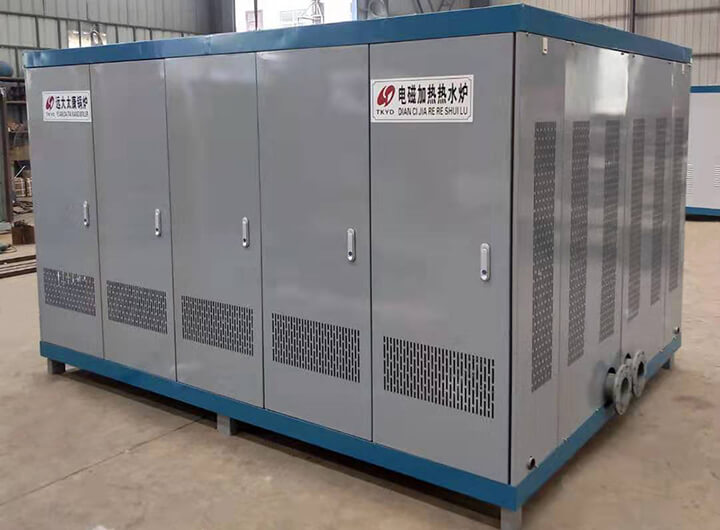
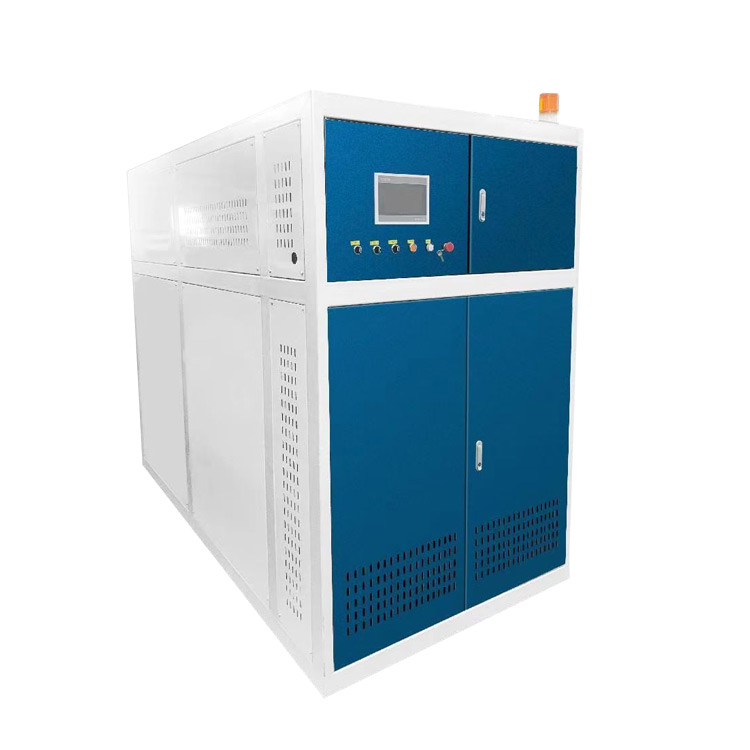
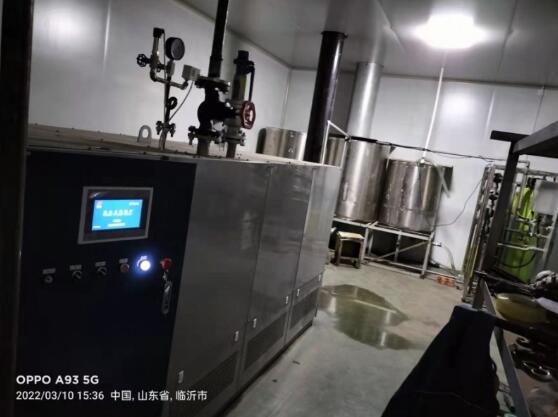
The DCR range is deliberately modular. Each unit is 80, 90, 100 or 120 kW, wall-hung or floor-standing, with an enclosure rated IP33 and a footprint small enough for a service cupboard. One module heats a guest house or a clinic wing; six modules in cascade heat a hotel. Because each module is a complete boiler with its own controls, a failure takes out one-sixth of the capacity rather than the whole building, and spare capacity can be added later without replacing the plant.
Heating is by induction: a coil energises the steel body of the unit, the body heats the water, and there is no immersed resistive element. The practical consequence is a boiler whose heating surface cannot burn out through low water or scale bridging, and whose response to a sudden draw is limited only by the pump and the pipework.
Flow temperature is adjustable between 30 °C and 90 °C in one-degree steps, which covers underfloor heating at 40 °C, fan coils at 60 °C and domestic hot water primary circuits at 80 °C. The controller holds the setpoint with a proportional band and stages the heating load in steps, so the unit does not swing between full power and off on a light load.
A frost protection function starts the pump and brings the water up to 5 °C if the return sensor falls near freezing. For a plant room in an unheated basement or a holiday let that is shut for weeks in winter, that single function justifies the electronics. The enclosure rating allows the unit to be installed in a plant room with normal humidity, though not in a wash-down area.
Modules are linked on a common header with a master controller that rotates the lead unit and brings lag units on in step. A well-set cascade will run two modules at part load rather than one at full load and one at zero, which reduces cycling and evens out running hours. The header should be sized for the total flow at 0.5 to 1.0 m/s, with isolation valves and strainers on each branch so that a module can be serviced while the rest run.
For domestic hot water, the cleanest arrangement is a plate heat exchanger between the boiler circuit and the potable water, with a buffer vessel on the primary side. That keeps the boiler water and the drinking water apart, allows the boiler to run at 70-80 °C while the hot water is drawn at 55 °C, and gives the draw-off a stable temperature through the heat exchanger’s control valve. A 120 kW module with a 500-litre buffer will serve roughly 40 rooms in a small hotel.
The circuit is closed, so make-up water is minimal and the water stays stable for years if it is filled correctly once. Fill with softened water, add a corrosion inhibitor suitable for mixed-metal systems, and fit a dirt separator on the return. Air is the main enemy: a circuit that draws air through a badly placed expansion vessel will corrode steel and brass, and the resulting sludge will settle in the boiler’s narrow passages.
An automatic air vent at the highest point and a deaerator on the make-up line are small costs that prevent most of the call-outs on this type of plant. Where the system is large, a side-stream filter keeps the water clear without frequent draining.
Electromagnetic hot water boilers suit buildings where a flue is impossible or expensive: listed buildings, basement plant rooms, inner-city sites with no chimney route, and retrofit projects where the existing boiler house is being converted to offices or flats. They also suit schemes with surplus low-carbon electricity, where the running cost argument turns on the tariff ratio rather than on the boiler.
Each megawatt-hour of heat costs the module about 1020 kWh on the supply meter, while a 92 per cent gas-fired unit burns some 110 Nm³ to do the same work; the running-cost comparison therefore turns on the local tariff ratio rather than on the boiler. Where power is cheap relative to gas, the electric option also strips out flue losses and the annual burner service.
Up to twenty modules on one master controller, which gives 2.4 MW at 120 kW each. The practical limit is usually the electrical supply and the header size rather than the control system.
Not directly from the boiler circuit. A plate heat exchanger separates the heating water from potable water, which is required in most jurisdictions and also keeps the boiler circuit clean and treated.
Annual checks of the electrical connections, coil cooling circuit, safety valve and expansion vessel, plus a water test. There are no elements to replace and no burner to service.
| Model | DCR-80S-C | DCR-90S-C | DCR-100S-C | DCR-120S-C |
|---|---|---|---|---|
| Rated power | 80 kW | 90 kW | 100 kW | 120 kW |
| Rated current | 121.6 A | 136.8 A | 152 A | 182.4 A |
| Supply | 380 V/50 Hz | 380 V/50 Hz | 380 V/50 Hz | 380 V/50 Hz |
| Heated area (reference) | 900-1600 m² | 1000-1800 m² | 1200-2000 m² | 1500-2400 m² |
| Hot water at 65 °C | 26 L/min | 29.3 L/min | 32.5 L/min | 39 L/min |
| Heating circuit pressure | 0.3 MPa | 0.3 MPa | 0.3 MPa | 0.3 MPa |
1 t/h
The WDR1-0.7 is a 1 t/h electric steam boiler producing 0.7 MPa steam at 170 °C. Heating elements sit in a horizontal shell with n...
View details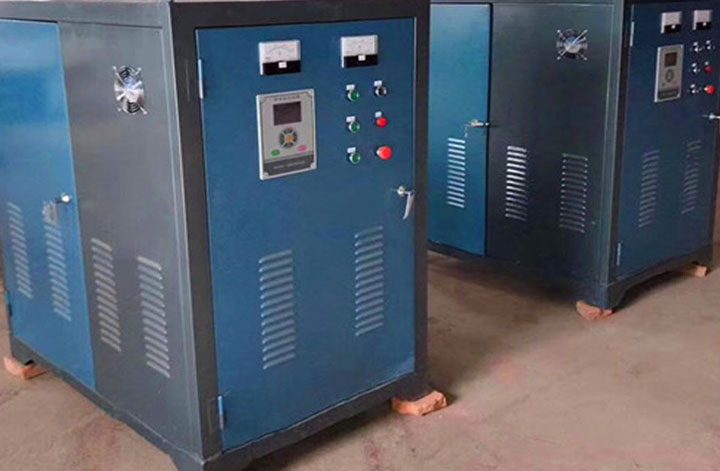
0.15-6 t/h
Induction-heated steam boiler, 0.15-6 t/h at 0.4-1.6 MPa, where the shell itself is the heating surface and there are no elements...
View details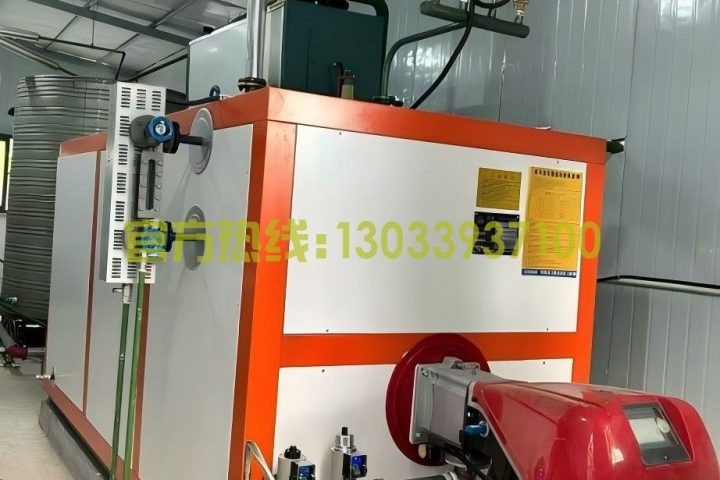
0.1-1 t/h from 50, 60, 80 or 100 kW modules
Parallel 50-100 kW electric steam modules, 0.1-1 t/h at 0.4-0.7 MPa, staged by PLC so part-load efficiency holds and one module is...
View detailsExternal links open the publisher’s website and are provided for background reading.
Include the capacity (t/h or MW), fuel, working pressure and site country so the proposal matches your permit limits.
We appoint one or two partners per country to quote, deliver and service our boilers locally. Territory protection, factory pricing and commissioning support are part of the agreement.