

2 t/h
2 t/h Gas/Oil Steam Boiler WNS2-1.25-Q
The WNS2-1.25-Q is a packaged three-pass wet-back fire-tube steam boiler rated at 2 t/h and 1.25 MPa, delivering 194 °C steam at 9...
View detailsSkid-mounted steam package combining boiler, burner, feedwater module, softener and controls in one enclosure, 0.3-2 t/h at 0.7-1.25 MPa.
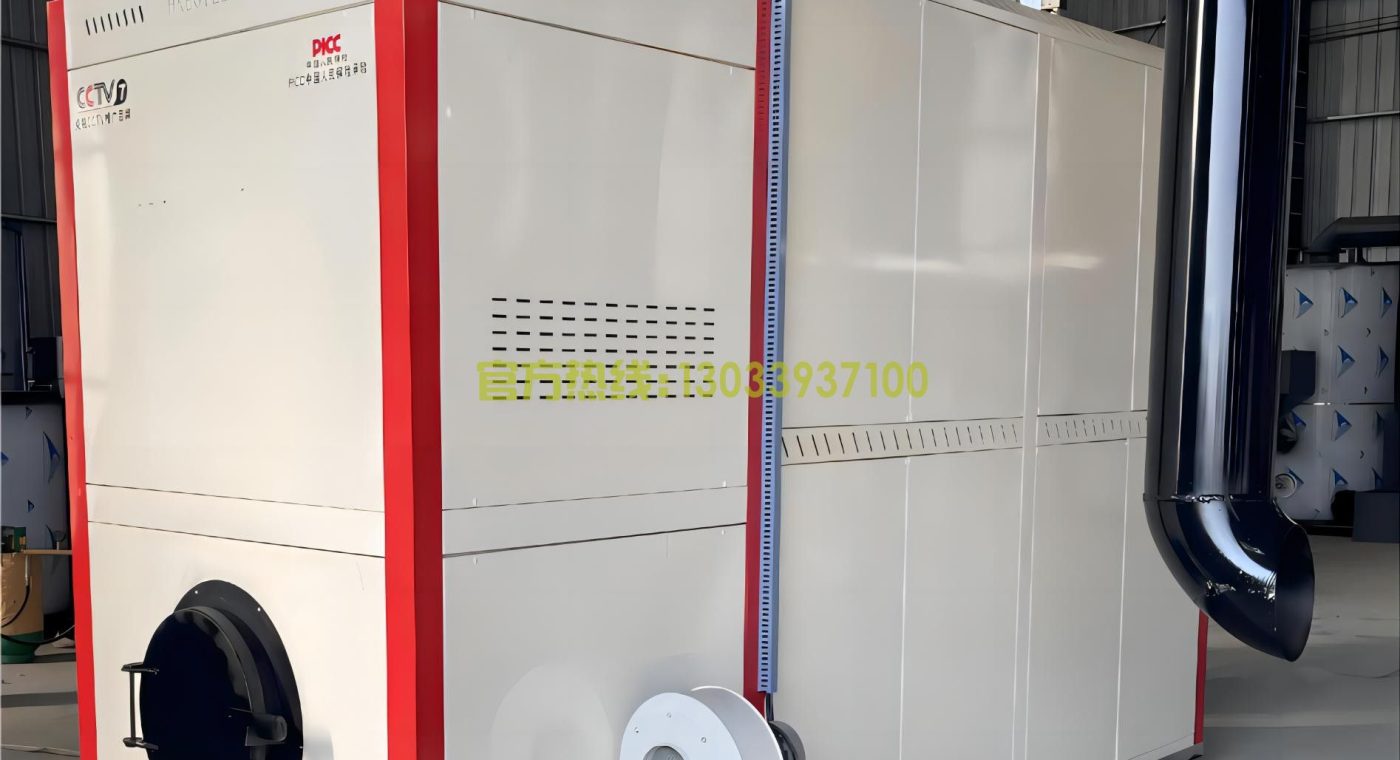
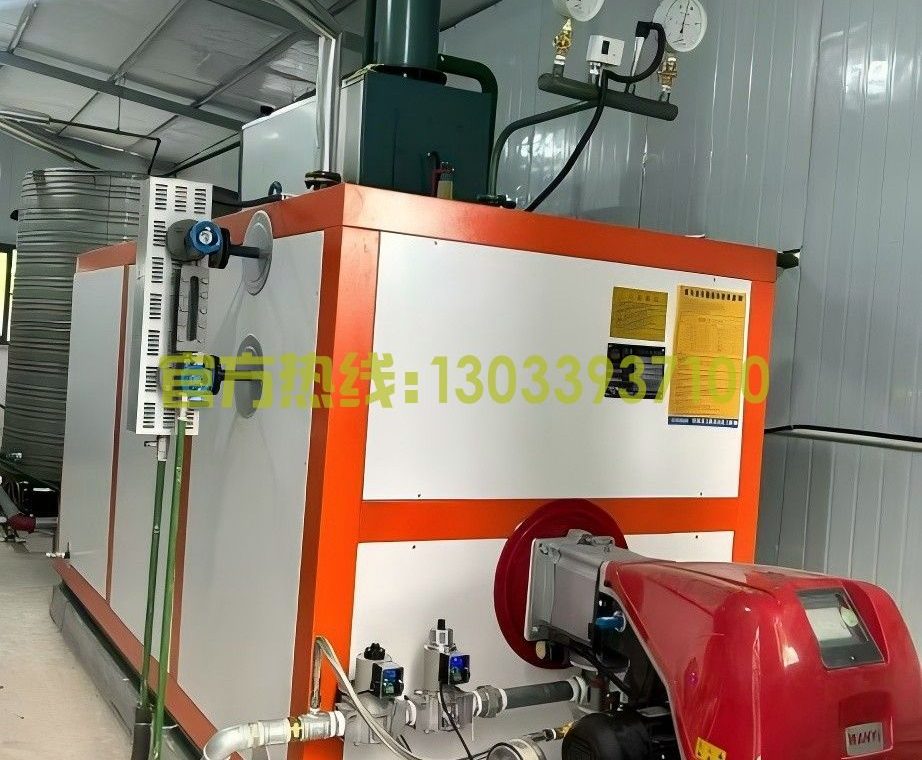
The unit is a steel skid carrying the boiler shell, burner, feedwater tank and pump set, water softener, control cabinet and flue connection, piped and wired to each other before dispatch. It arrives as one lift, sits on a flat slab, and needs four connections: cold water in, steam out, blowdown out, flue up. Everything between those points was assembled and pressure-tested in a workshop.
The range is 0.3 to 2 t/h at 0.7 to 1.25 MPa. Above 2 t/h the skid grows past what is sensible to ship and lift, and a conventional boiler room becomes the better answer; below 0.3 t/h a steam generator is cheaper. The format earns its place in the band between.
Boiler and burner are conventional: a three-pass wet-back shell with a matched modulating burner. The feedwater module is a 0.5 to 2 m³ tank with duty and standby pumps, level controls and a low-water cut-off independent of the modulating probe. The softener is a twin-tank automatic unit sized on the water analysis, inside the frame rather than beside it. One PLC runs level, pressure, burner staging, regeneration and alarms.
What it does not contain is a deaerator, an economiser or blowdown heat recovery; those need height, and putting them on the skid would defeat it. After softening, feedwater still holds 6 to 8 mg/L of dissolved oxygen at 20 °C, tolerable for a low-pressure shell at moderate load but not good practice for continuous running. Above about 6,000 hours a year, a small deaerator or an oxygen scavenger belongs in the scope, and the layout should leave room for it.
A 1 t/h skid occupies about 3.4 by 1.9 m, or 6.5 m², and stands 2.6 m to the flue spigot. A traditional 1 t/h room with boiler, feed tank, softener, pumps, deaerator, blowdown tank and inspector’s walkways takes 45 to 60 m², plus a chimney foundation and an electrical room. The building disappears, and with it the civil works, the fire separation and the roof penetration.
Access still has to be planned: a metre clear at the burner end for the flame and the burner swing, 0.8 m along one side for tube access, and headroom for the safety-valve discharge. A unit pushed into a corner with its burner facing a wall is a service problem for its whole life.
Four field connections replace the fifteen to twenty joints of a conventional room. There, the pipework between boiler, feed tank, softener, pumps and deaerator is cut, welded, tested and insulated on site by whichever contractor is available. Here it was done on a jig, tested to 1.5 times design pressure and insulated before painting.
Electrically the skid takes one three-phase feeder, 15 kW at 1 t/h and 25 kW at 2 t/h, through a single isolator on the frame; burner fan, pumps, softener motor and controls all come off it. Against four separate supplies with four protection arrangements, that is the difference between an electrician spending a day and spending a week.
An open skid with a 1 t/h burner runs at 78 to 82 dB(A) at one metre, mostly fan and combustion noise from the burner throat. A canopy brings that to 68 to 72 dB(A), enough to stand beside a production hall, provided it has a combustion-air path and does not cook the controls. Heat rejection is 1 to 1.5 per cent of firing rate, so a 1 t/h unit puts 10 to 15 kW into the room and needs about 1,500 m³/h of ventilation; without it the combustion air thins and the flame turns unstable.
Food plants adding a line, laundries, small hospitals and pilot plants buy this format because the steam demand is real, the capital is limited, and nobody wants a building project. It also suits export sites where labour is expensive, because the work moves into the workshop. The limits are the 2 t/h ceiling, no heat recovery, and a footprint that will not compress below about 4 m².
A canopy version can stand outdoors in mild climates, with freeze protection on the feedwater module and a weatherproof control cabinet. In frost-prone locations it is better indoors or under a simple shelter, because the feed tank and pump casing are the parts that freeze first.
Two options: a second skid in parallel, which also gives standby capacity and better turn-down, or a conventional boiler room. Adding a second 1.5 t/h skid is usually cheaper and faster than rebuilding one 3 t/h unit, and each can be isolated for service.
It is sized on a water analysis, not on a standard assumption. Hardness above about 3 mmol/L, high iron or high turbidity each change the resin volume and the regeneration schedule, so the analysis should be sent with the enquiry rather than after the order.
| Size class | 0.3 t/h | 0.5 t/h | 1 t/h | 2 t/h |
|---|---|---|---|---|
| Rated evaporation | 0.3 t/h | 0.5 t/h | 1 t/h | 2 t/h |
| Footprint L×W | 2.6×1.6 m | 3.0×1.7 m | 3.4×1.9 m | 4.2×2.1 m |
| Skid weight, wet | 4.5 t | 5.5 t | 7.5 t | 11 t |
| Installed electrical | 8 kW | 10 kW | 15 kW | 25 kW |
| Steam connection | DN40 | DN50 | DN65 | DN80 |
2 t/h
The WNS2-1.25-Q is a packaged three-pass wet-back fire-tube steam boiler rated at 2 t/h and 1.25 MPa, delivering 194 °C steam at 9...
View details6 t/h
The WNS6-1.25-Q is a packaged three-pass wet-back fire-tube steam boiler rated at 6 t/h, 1.25 MPa and 194 °C, firing natural gas,...
View details
1-100 t/h
Two-pass wet-back steam boiler with economiser and condensing tail, designed for 30 mg/Nm³ NOx and a stack temperature near 55 °C.
View detailsExternal links open the publisher’s website and are provided for background reading.
Include the capacity (t/h or MW), fuel, working pressure and site country so the proposal matches your permit limits.
We appoint one or two partners per country to quote, deliver and service our boilers locally. Territory protection, factory pricing and commissioning support are part of the agreement.