
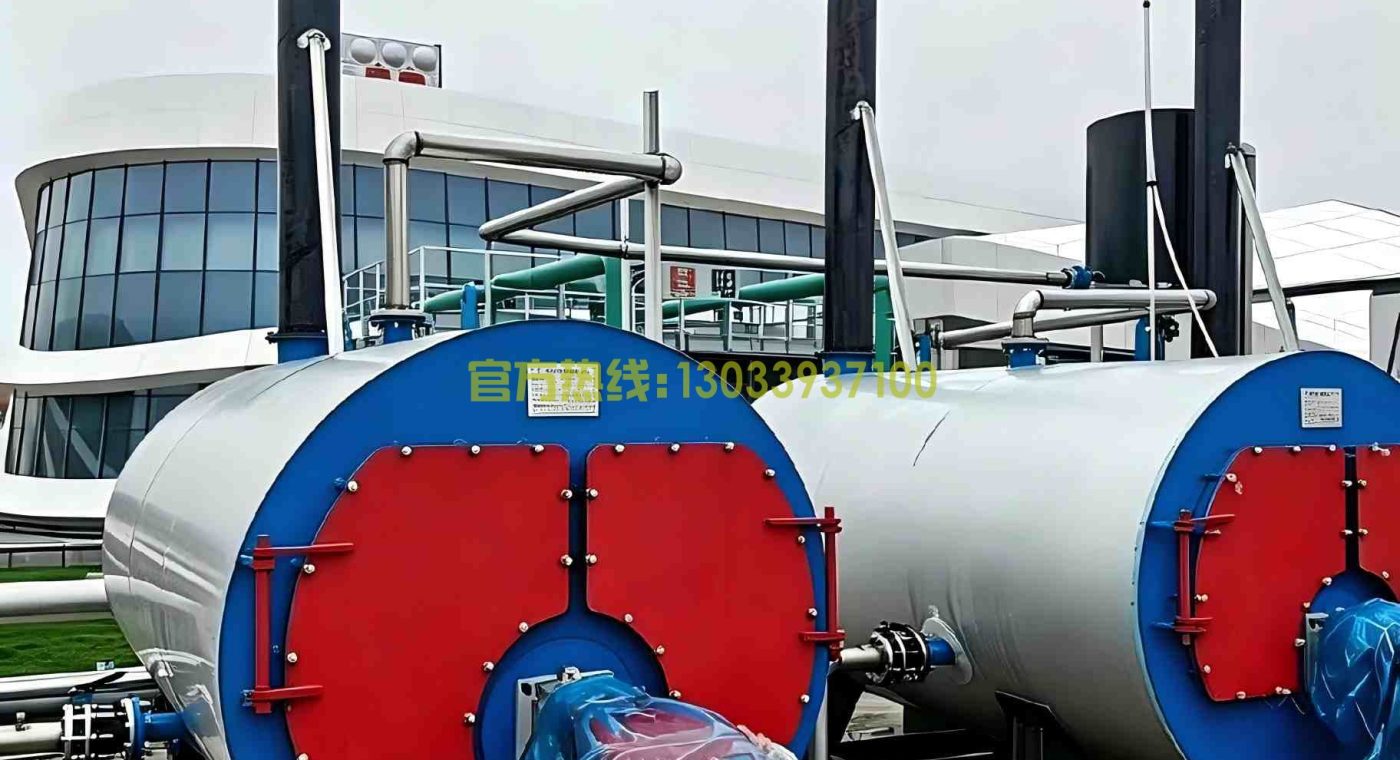
Storage changes the shape of the load, not its average
A steam accumulator is a horizontal pressure vessel two-thirds full of saturated water. It stores energy as sensible heat in that water, not as steam. Charging steam from the boiler passes through a distributor at the bottom and condenses, raising the water temperature and the vessel pressure. When a press, a batch cooker or a rolling mill opens a valve, the vessel pressure falls, the water flashes, and the released steam supplies the difference. The boiler keeps running at a steady rate while the accumulator absorbs the peaks.
The economics are easy to state and harder to size. A plant drawing 4 t/h for twenty minutes in every hour has an average demand of 1.3 t/h but a peak that would otherwise force a 4 t/h boiler, feedwater train and chimney. An accumulator sized for the peak lets a 1.5-2 t/h boiler run flat out all day, which is better for efficiency, emissions and equipment life. Whether it beats the bigger boiler depends on peak duration and pressure band.
The flash fraction, which sets everything
The useful storage is the difference in sensible heat between the charged and discharged states, divided by the latent heat at the lower pressure. Take a vessel charged at 1.6 MPa and discharged to 0.6 MPa. Saturated water enthalpy falls from about 858 kJ/kg to 670 kJ/kg, a difference of 188 kJ/kg, and the latent heat at 0.6 MPa is about 2,086 kJ/kg. Each kilogram of stored water therefore releases 188/2,086 = 0.09 kg of steam.
That figure is small, which is why accumulators are large. A 40 m³ vessel holds about 27 t of water at two-thirds fill and releases roughly 2.4 t of steam during a drawdown, enough to carry a 2 t/h deficit for over an hour. The same vessel charged to 1.0 MPa and discharged to 0.5 MPa releases only about 0.04 kg per kilogram, or 1.1 t, because the enthalpy drop is smaller.
Two conclusions follow. Charge as high as the boiler and the process allow, and discharge as low as the process will tolerate. A pressure band of 1.6 to 0.4 MPa stores four times as much as 1.0 to 0.7 MPa, and the control system should be set to use the whole band rather than holding the vessel near its charging pressure.
Sizing from the load curve
The input is a load duration curve, ideally metered at one-minute intervals over a representative week. From it, take the largest deficit between the boiler’s steady output and the demand, and the duration of that deficit. The steam to be supplied is the deficit multiplied by the duration, and the water volume follows from the flash fraction with a margin for the fact that the last part of the drawdown is at low pressure and poor quality.
For the 4 t/h peak with a 1.5 t/h WNS boiler, the deficit is 2.5 t/h. If the peak lasts 15 minutes, the steam required is 0.625 t. At 0.09 kg per kilogram, the water needed is 6.9 t, which in a vessel at two-thirds fill means about 10.4 m³. A 15 m³ vessel covers it with a comfortable margin. If the same peak lasts 40 minutes, the requirement is 1.67 t of steam, 18.5 t of water and a 28 m³ vessel, at which point the accumulator is competing with a larger boiler on cost.
The charging rate matters as much as the volume. If the vessel is discharged by 2.4 t and the boiler has only 20 minutes at a 0.5 t/h surplus, it will not recover before the next peak, and the system becomes a boiler running flat out with an empty accumulator. Size the boiler so its surplus over the average load can recharge the vessel in the available interval, and check the arithmetic over a full shift.
Pressure, control and the boiler interface
The accumulator connects to the steam main through a large control valve, with the vessel pressure as the measured variable. A simple and robust scheme holds the boiler at a constant pressure and lets the vessel float: when the main pressure falls, the valve opens and the accumulator discharges; when it rises, the valve opens the other way and the vessel charges. The boiler sees a nearly constant load, which is what it wants.
The valve must pass the full discharge flow at a small pressure difference, which means a large body. It should fail closed on air failure and have a manual bypass. A transmitter on the vessel, a second on the main and a trend of both is enough instrumentation; the failure modes show in the trends long before they become trips.
The boiler interface has two constraints. Neither a fire-tube nor a water-tube unit should be asked to swing from 30% to 100% every few minutes, which is exactly what the accumulator prevents. And because the boiler now runs at a constant high output, the feed pump and deaerator must be sized for continuous maximum flow rather than the old average.
Limits and failure modes
An accumulator is a large vessel holding water at saturation, with a steam connection at the top. Water hammer is the classic failure: if the vessel is overfilled, or the outlet baffle is missing, a hard drawdown sends water into the steam main, where it accelerates and damages valves and bends. The level must be controlled within a band, with a high-level alarm and a trip on the charging valve, and the outlet should have a cyclone or a wire-mesh drier.
Thermal stratification is the quiet failure. A vessel that is never fully charged develops a layer of cooler water at the bottom and a hot layer at the top, and the usable storage falls without any visible symptom. The cure is to charge to the design pressure regularly, and to measure the water temperature at two heights rather than trusting the pressure gauge alone. Insulation matters for the same reason: a bare accumulator loses more heat in a day than it stores in an hour.
The table gives the stored steam for standard vessel sizes over the two pressure bands most often used. It is a starting point for the sizing calculation, not a substitute for it.
| Nominal volume | Water at two-thirds fill | Steam, 1.6 to 0.6 MPa | Steam, 1.0 to 0.5 MPa | Peak supported for 15 min |
|---|---|---|---|---|
| 5 m³ | 3.3 t | 0.30 t | 0.13 t | 1.2 t/h |
| 15 m³ | 10 t | 0.90 t | 0.40 t | 3.6 t/h |
| 40 m³ | 27 t | 2.4 t | 1.1 t | 9.6 t/h |
| 80 m³ | 53 t | 4.8 t | 2.1 t | 19 t/h |
Note the last column: the same vessel supports twice the peak if the peak lasts half as long. Sizing therefore always starts with the duration, and a plant that quotes a peak in tonnes per hour without saying for how long has not given enough information to size anything.
The alternative is a second boiler or a larger one, and the comparison is not only capital cost. A boiler sized for the peak runs at 30-40% load most of the day, cycling and condensing in the stack. An accumulator plus a smaller boiler keeps both machines in their efficient band. Where the peak is short and repetitive the accumulator wins on operating cost; where it is long or unpredictable, the second boiler is the honest answer.


