
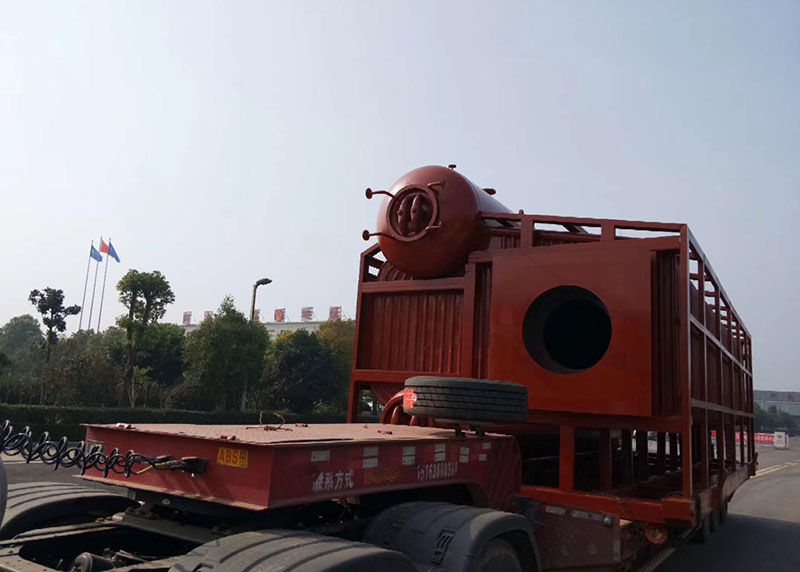
What actually ships
An industrial boiler is not a container of boxed goods. A 10 t/h water-tube unit leaves the works as two modules weighing 40 t and 26 t, each wider than a standard container and taller than a flat rack allows. A 4 t/h fire-tube boiler ships as one packaged unit of about 12 t, which does fit a 40 ft flat rack. The shipping method follows from the dimensions, and the dimensions are fixed at the drawing stage, long before anyone books freight.
This is why export projects start with a transport study rather than a quotation. The route from the works to the port, the crane capacity at both ends, the width restrictions on the road and the vessel type all feed back into how the boiler is split. A boiler designed as a single module that then has to be cut at the port is a warranty problem waiting to happen.
Splitting and packing for the voyage
The module split is set by the heaviest lift and the widest road, not by thermodynamics. For the 10 t/h unit, the lower furnace and membrane walls travel as one piece and the drum and convective section as another, with the site welds designed and procedurally qualified for erection. Every split flange or weld preparation is match-marked and photographed before dispatch.
Inside the module, the pressure parts need bracing against racking and vibration over 20-30 days at sea. Membrane walls are blocked with timber to stop relative movement; the drum is strapped to the frame; tube stubs are capped and the caps are checked at loading. Refractory travels as bagged castable rather than pre-cast shapes, because a pre-cast arch that survives the road may crack when the ship works in a swell.
Packing follows the mode. Sea freight needs ISPM 15 heat-treated timber, a vapour barrier inside the crate, and desiccant sized for the voyage. Instruments, burner parts, valves and control panels travel in a separate sealed case with shock indicators. A common failure is packing the small parts inside the boiler casing, where they are found after erection, wet and unidentifiable.
The commercial document set
The documents must agree with each other to the character. A letter of credit will be rejected for a discrepancy between the invoice and the packing list, and the shipment then sits at the port while the vessel sails. Build the set from the credit, not from habit.
| Document | Issued by | Purpose |
|---|---|---|
| Commercial invoice | Exporter | Customs value, payment |
| Packing list | Exporter | Weight, dimensions, marks per case |
| Bill of lading | Carrier | Title, on-board date, freight terms |
| Certificate of origin | Chamber of commerce | Tariff preference, import licence |
| Insurance certificate | Insurer | Marine cargo cover to the named port |
| Fumigation and ISPM 15 marks | Treatment provider | Wood packaging acceptance |
| Inspection certificate | Third-party inspector | Pre-shipment condition and conformity |
| Mill test certificates | Steel mill | Pressure-part material traceability |
| Welding and radiography reports | Manufacturer | Pressure-part quality record |
| Hydrostatic test certificate | Manufacturer | Proof of pressure integrity |
| Safety valve certificate | Manufacturer or tester | Set pressure and capacity |
| Operation and maintenance manual | Manufacturer | Installation, operation, spares |
The pressure-part file
Most destination authorities will not release a boiler without a pressure-part file, and the file is not the same as the commercial documents. It contains the design calculations and drawings, material certificates traceable to the heat number, the qualified welding procedures and welder certificates, radiography or ultrasonic reports for the main seams, the hydrostatic test record and the safety valve setting record.
The file should travel with the goods in a sealed folder, with a copy in the control panel and a scanned set sent ahead by email. Inspectors ask for specific pages, not the whole file, and a plant that can produce them within a day avoids a week of demurrage. Translate the cover sheets and the certificates into the destination language or English; a file entirely in Chinese is a common reason for delay in markets where the inspector cannot read it.
Where the buyer appoints a third-party inspector, agree the inspection points before manufacture: material identification, dimensional check, radiography review, hydrostatic test and final painting. Each hold point that is missed becomes a re-inspection fee and a schedule slip.
Marking, loading and the voyage
Shipping marks go on two faces of every case, with the case number, gross and net weight, dimensions, centre of gravity and lifting points. The boiler base is marked with the lifting sling positions, because a crane driver who guesses will bend the casing. Fragile items carry the standard handling symbols, and the heaviest module carries its own lift plan in the document folder.
Loading is supervised by the manufacturer’s engineer or a nominated surveyor, with photographs of every lift and every lashing. A 40 t module on a break-bulk vessel needs cribbing under the base and lashings calculated for the stow position, not for a generic container. The surveyor’s report is the evidence if the cargo arrives with damage, and it is worth the fee on any shipment above a single container.
Sea transit from a Chinese port to the Middle East or Europe is typically 20-35 days, and to South America 35-45. Add 7-10 days for inland transport at each end, plus customs clearance. The total is why the production lead time of 25-45 days after drawing approval is only part of the schedule the buyer should plan against.
Where shipments stall
The most common delay is a document discrepancy: a weight that differs by 2% between invoice and packing list, an HS code that does not match the destination’s tariff schedule, or a certificate of origin that was not legalised. The second is packing: timber without an ISPM 15 stamp is refused or fumigated at the buyer’s cost, and a crate with no desiccant arrives with rusted internals.
The third is the inspection sequence. A boiler that is painted before the third-party inspector has seen the hydrostatic test has to be opened again. Agree the hold points in writing and do not paint, pack or load until each one is signed off.
None of this is engineering, and all of it decides whether the boiler arrives on the date the plant needs it. The projects that go smoothly are the ones where the shipping plan was drawn up with the general arrangement drawing, and the document set was built from the letter of credit before the first weld was made.


