
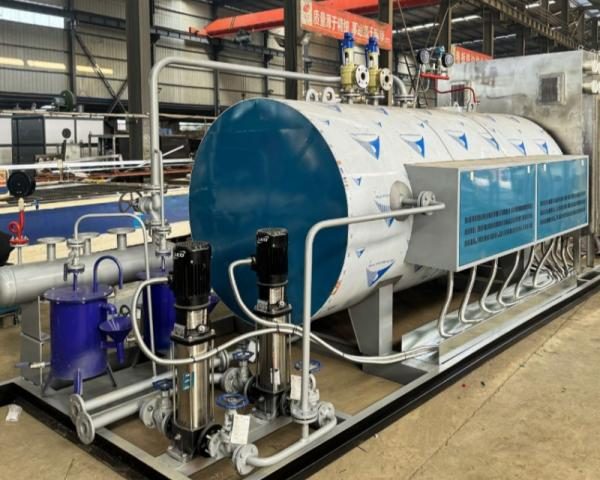
0.5-4 t/h
Mobile Trailer Steam Boiler Unit, 0.5-4 t/h
Trailer-mounted packaged steam boiler, 0.5-4 t/h at 1.0-1.25 MPa, with burner, feed pump, water tank, control panel and stack on o...
View detailsTwo-pass wet-back steam boiler with economiser and condensing tail, designed for 30 mg/Nm³ NOx and a stack temperature near 55 °C.
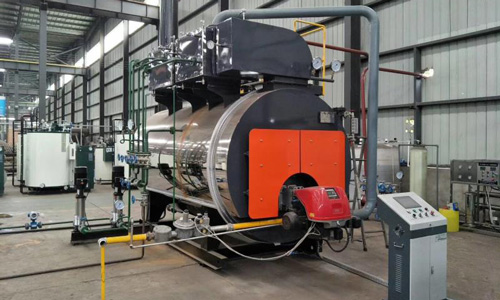
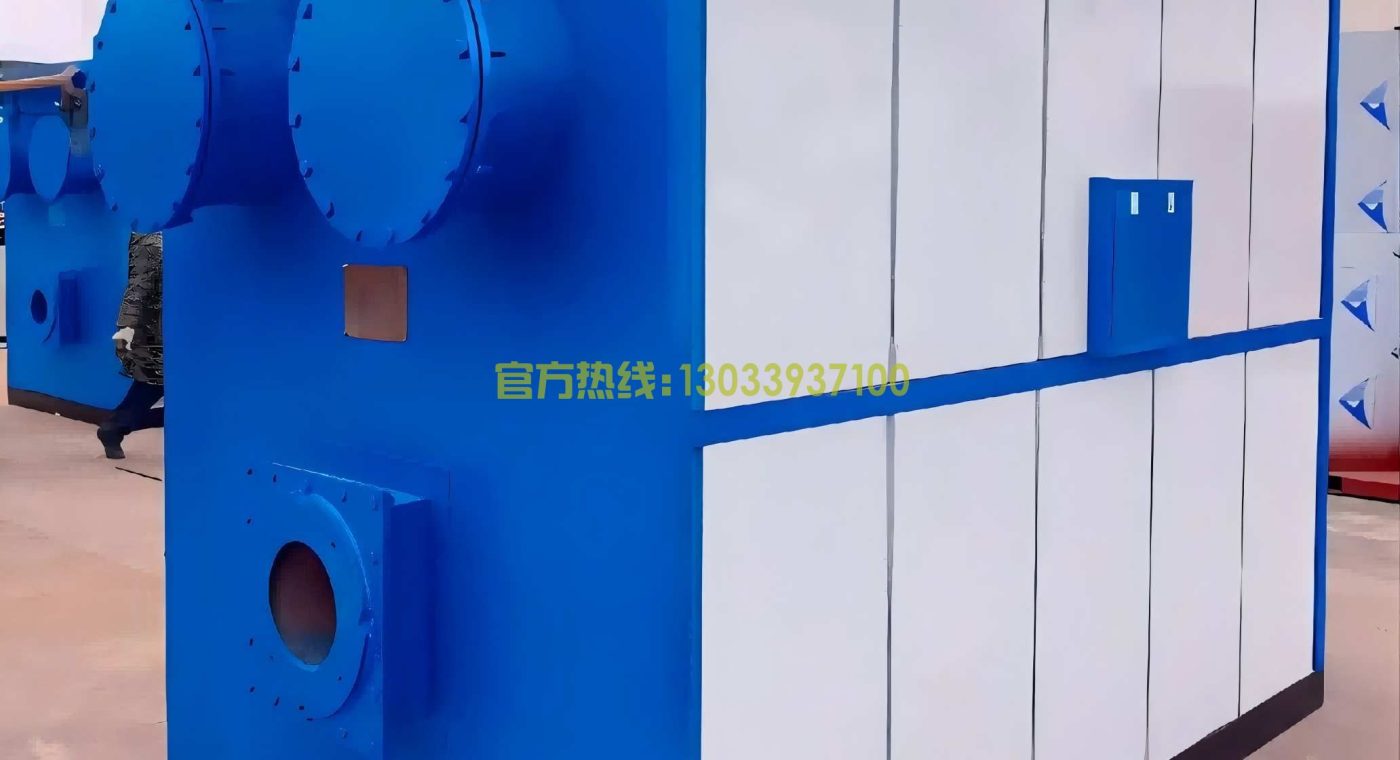
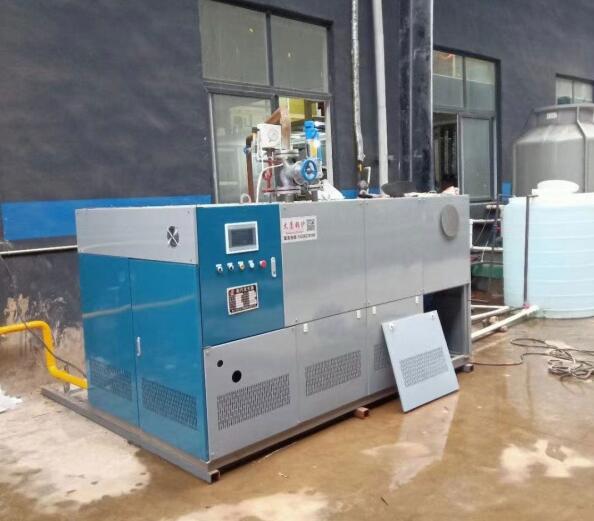
The low-NOx condensing steam boiler keeps the shell simple and puts the engineering into the back end. Gas burns in a corrugated furnace that forms the first pass, turns in a water-backed reversal chamber, and crosses a single threaded-tube bundle as the second pass. The rear tubesheet is shielded from direct radiation by that chamber, which is why the design can afford only two passes: the heat it would have taken out in a third pass is recovered downstream instead, where the gas is cooler and the surface can be made of cheaper, corrosion-resistant material.
After the second pass the gas crosses an economiser that heats feedwater from 20 °C to roughly 90 °C, then a condenser that takes the last useful heat out against cold make-up water. The stack leaves at 52-56 °C. At that temperature the water vapour in the products of combustion has largely condensed, and the latent heat released is what lifts the calculated efficiency from the low nineties into the high nineties.
Thermal NOx forms when nitrogen and oxygen meet at high temperature for long enough. Flue-gas recirculation attacks both terms. A controlled fraction of cooled flue gas, typically 10-20%, is drawn from the tail and mixed into the combustion air; the inert carbon dioxide and water vapour dilute the oxygen in the flame from about 21% to nearer 18%, and the flame temperature drops by well over 100 °C. Peak temperature falls below the threshold where atmospheric nitrogen oxidises quickly, and NOx falls with it.
The cost is real. Recirculation raises fan power, narrows the stable flame envelope at low fire, and puts a wet, acidic gas stream into the burner air path, so the ducting and the mixing orifice need corrosion protection and a condensate drain. Staged combustion, where part of the air is admitted downstream of the flame core, is used alongside it to finish the burn without rebuilding the peak temperature.
We design this series against a 30 mg/Nm³ target at 3% oxygen, which is the limit applied in the strictest Chinese urban regulations and in several export markets. That figure is a design aim, verified on a unit-by-unit basis by a stack test after commissioning; it is not a certificate that travels with the boiler. Sites with tighter local limits, or with a burner adjusted for a lower recirculation rate, need a case-by-case check.
Condensing only happens if the surface is below the dew point of the gas, around 55-60 °C for natural gas. In a steam plant the condensate returning from the process is already at 80-95 °C, so the condenser has to work against cold make-up instead. The practical consequence is that the condensing credit tracks the make-up rate: a plant with high condensate return gets less of it than a plant that feeds a lot of cold softened water.
The condenser drains acidic condensate, roughly 1.5 kg per Nm³ of gas when the gas is fully condensed, and that has to go to a neutralisation pit before the drain. Finned tubes are ND steel, a weathering grade that tolerates the dilute sulphuric and nitric mix far better than carbon steel; stainless is used where chloride in the make-up is high.
Oxygen trim on the flue keeps excess air at about 7-8% across the firing range, which protects the efficiency figure at part load where most boilers lose it. Level control is electrode-based with a modulated feedwater valve, and the burner is interlocked on low water, high pressure and flame failure in the usual way. Remote monitoring over a mobile network link is available for plants without a permanent boiler operator.
The economics favour continuous duty. A boiler running 6,000 hours a year at 4 t/h burns roughly 1.9 million Nm³ of gas; four points of efficiency is around 75,000 Nm³, which usually covers the condenser’s capital cost inside two years at typical industrial tariffs. A standby boiler running 500 hours a year will not pay it back, and a plain WNS with an economiser is the better buy there.
It is the design target at 3% oxygen, and the figure is confirmed by a stack test after commissioning. Because it depends on burner adjustment, gas quality and load, we treat it as a performance aim rather than a certification.
Only while the condenser surface stays below the gas dew point, which in practice depends on how much cold make-up water is available. With high condensate return the condensing credit shrinks and the efficiency sits nearer the 97% design figure.
The shell can, but the condensing tail is designed for gas. Oil brings sulphur, the dew point rises above the achievable stack temperature, and the condenser would run wet with acid, so oil firing is normally limited to a non-condensing configuration.
| Model | WNS1-1.25-Q | WNS2-1.25-Q | WNS4-1.25-Q | WNS6-1.25-Q |
|---|---|---|---|---|
| Rated evaporation | 1 t/h | 2 t/h | 4 t/h | 6 t/h |
| Rated steam pressure | 1.25 MPa | 1.25 MPa | 1.25 MPa | 1.25 MPa |
| Design efficiency | 97.45% | 97.43% | 97.45% | 97.58% |
| Efficiency with condensing credit | 100.6% | 100.58% | 100.6% | 100.73% |
| Design flue-gas temperature | 55.2 °C | 55.6 °C | 55.2 °C | 52.1 °C |
| Gas consumption (LNG) | 79 Nm³/h | 158 Nm³/h | 314.4 Nm³/h | 470.9 Nm³/h |
0.5-4 t/h
Trailer-mounted packaged steam boiler, 0.5-4 t/h at 1.0-1.25 MPa, with burner, feed pump, water tank, control panel and stack on o...
View details
6 t/h
The WNS6-1.25-Q is a packaged three-pass wet-back fire-tube steam boiler rated at 6 t/h, 1.25 MPa and 194 °C, firing natural gas,...
View details
50 t/h
The SZS50-1.6-Q is a 50 t/h D-type double-drum water-tube boiler delivering 1.6 MPa steam at 204 °C. It achieves 95% efficiency (L...
View detailsExternal links open the publisher’s website and are provided for background reading.
Include the capacity (t/h or MW), fuel, working pressure and site country so the proposal matches your permit limits.
We appoint one or two partners per country to quote, deliver and service our boilers locally. Territory protection, factory pricing and commissioning support are part of the agreement.