
A thermal oil loop is not a steam boiler
2.8 MW at 300 °C is the working point for a chemical plant in Tema, Ghana, where the plant replaced 8.5 MPa steam with an oil loop to cut operating cost. The unit was selected on that operating pattern rather than on a catalogue rating, and the difference shows in how it holds pressure on the worst shift of the week.
Thermal oil delivers 300 °C at less than 1 MPa, which is why it replaces high-pressure steam in asphalt, chemical and textile plants. There is no phase change, no traps, no blowdown and no water treatment, but there is a different set of limits: the oil degrades at the film temperature, not the bulk temperature, and a stopped pump can coke a coil in minutes.
Numbers that decide the design
At 2.8 MW and 300 °C the unit absorbs about 2.8 MW. On natural gas at roughly 90% efficiency, full-load demand is about 315 Nm3/h. The figures are stated at the site’s conditions, because ambient temperature, altitude and fuel analysis all move them.
| Item | Value |
|---|---|
| Rated output | 2.8 MW |
| Pressure / temperature | 300 °C |
| Fuel | natural gas |
| Full-load fuel demand | 315 Nm3/h |
| Thermal efficiency | about 90% |
What to watch on site
The loop is designed around velocity. Tubes are sized so oil moves faster than about 1.5 m/s at full flow, which keeps the wall film inside the oil’s limit. A minimum-flow bypass protects the coil when process valves close, the expansion tank is nitrogen-blanketed to stop oxidation, and warm-up is limited to 30-50 K per hour. Oil samples every 500 hours track viscosity, flash point and insolubles.
Site note: the plant replaced 8.5 MPa steam with an oil loop to cut operating cost. The operators log header pressure and stack temperature every two hours, which is enough to see fouling and load drift before either becomes a shutdown.
Why it matters
A thermal oil loop is not a steam boiler is not a detail to settle after the order. It decides the shell size, the burner, the feedwater train and the maintenance calendar, and it is cheaper to get right in the specification than in the boiler house.
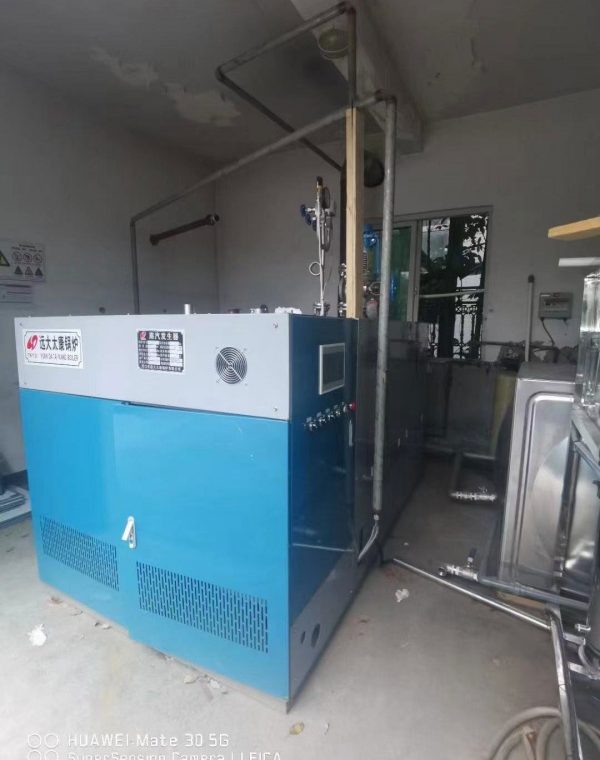
Equipment used in this kind of plant: gas thermal oil heater and heat exchanger. The industry side is covered in this solution page, and project cases show comparable installations.
Background reading: external reference on steam and process heat.
Questions plant engineers ask
Why not use steam at 300 °C?
Saturated steam at 300 °C needs about 8.5 MPa, with high-pressure pipework, water treatment, a deaerator and licensed operators. An oil loop does the same duty at 0.6 MPa.
What kills thermal oil?
Film temperature and oxygen. Low flow raises the film temperature even at a correct outlet temperature, and an unblanketed expansion tank oxidises the oil.
Related note: 2.8 MW Thermal oil heater in Sudan: A thermal oil loop is not a steam boiler


