
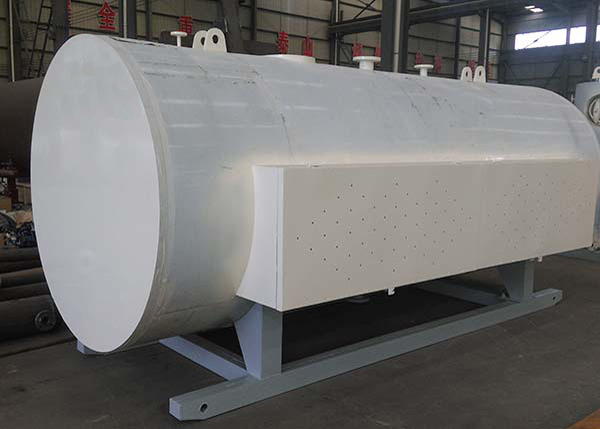
Working pressure is one of the first numbers fixed in a boiler specification, and it is often chosen by habit rather than calculation. The three common ratings for industrial steam boilers — 0.7 MPa, 1.0 MPa and 1.25 MPa (roughly 7, 10 and 12.5 bar gauge) — correspond to saturated steam temperatures of about 170 °C, 184 °C and 194 °C. Choosing too low a rating starves the process at peak demand; choosing too high a rating raises shell thickness, valve class and inspection obligations for no process benefit. This article sets out how to match the rating to process temperature, distribution losses and the applicable safety category.
Start from the process temperature, not the boiler
Saturated steam temperature is fixed by pressure. The table below gives representative values (IAPWS-IF97 saturated steam, gauge pressure at sea level; altitude and superheat not considered).
| Working pressure (MPa g) | Approx. bar g | Saturated steam temp. (°C) | Latent heat (kJ/kg) | Typical fit |
|---|---|---|---|---|
| 0.7 | 7 | ≈170 | ≈2048 | Low-temperature process heat, jacketed vessels, some food and textile duties |
| 1.0 | 10 | ≈184 | ≈2015 | General process steam, CIP, dryers, most building and industrial steam systems |
| 1.25 | 12.5 | ≈194 | ≈1985 | Higher-temperature process, long or heavily loaded distribution, margin for future load |
Assumptions: saturated steam, gauge pressure, no superheater, no condensate subcooling credit. Values are indicative; use steam tables for design.
The rule of thumb: the boiler rating must exceed the highest saturation temperature any user needs, plus the pressure drop to that user. If a reactor jacket needs 175 °C, 0.7 MPa steam at the boiler is already marginal before any line losses — 1.0 MPa is the safer starting point. Note that latent heat falls as pressure rises, so higher pressure delivers slightly less energy per kilogram of steam; the gain is temperature and transport capability, not efficiency.
Allow for distribution losses and control margin
Pressure falls along the pipe run through friction and fittings. A working allowance of 0.1–0.2 MPa between boiler outlet and the furthest user is common in medium-sized plants; long runs, undersized headers or heavily throttled control valves can consume more. Two further margins matter:
- Control valve authority: a modulating valve needs a pressure drop across it to control. If the boiler is sized exactly to the user’s saturation pressure, the valve has nothing to work with at full load.
- Peak simultaneous demand: pressure sags when several users open at once. The boiler rating should hold setpoint at design peak, not average load.
Worked example: a plant with users needing 180 °C at the far end, 150 m of main, and a design peak of 6 t/h. Required saturation pressure at the user is about 1.0 MPa; add 0.15 MPa for line and valve losses and the boiler should be rated at 1.25 MPa, not 1.0 MPa. Conversely, a compact plant with 165 °C users and short runs is well served by 0.7 MPa. Sizing the steam load itself is covered in our capacity and cost guide.
Safety category and what the rating changes
In most jurisdictions the pressure rating determines the pressure-vessel category, and with it the design code, wall thickness, inspection interval and operator requirements. Higher ratings mean thicker shells and tubes, higher-class valves and flanges, and more demanding periodic inspection. The practical consequence is that every step up in rating carries a cost and administrative burden that should be justified by process need. Confirm the classification rules that apply where the boiler is installed; they vary by country and by volume and pressure thresholds.
Two engineering points follow. First, do not specify 1.25 MPa “for safety” if 1.0 MPa meets the process — the safety margin belongs in the design calculation, not in an arbitrary uplift. Second, do not specify 0.7 MPa to avoid inspection if the process genuinely needs 184 °C steam; the boiler will run at its limit with the safety valve lifting or the burner cycling.
Matching the rating to the boiler type
Fire-tube and water-tube designs have different natural pressure ranges. Fire-tube boilers are commonly built for 0.7–1.25 MPa and are a good fit for the duties above; water-tube designs extend to higher ratings where process temperature demands it. If your required temperature sits well above 194 °C, the discussion moves to higher-pressure or superheated options rather than these three ratings. Review the available configurations in our product range before fixing the specification.
Checklist before you fix the rating
- List every steam user with its required temperature and simultaneous peak load.
- Convert each required temperature to saturation pressure using steam tables.
- Add line, fitting and control-valve pressure drop to the furthest user.
- Add a control margin (typically 0.1–0.2 MPa total) and check the boiler holds setpoint at peak.
- Confirm the pressure-vessel category and inspection obligations for each candidate rating.
- Check feedwater quality and blowdown provisions — higher pressure and temperature raise the stakes on water treatment.
- Confirm the safety valve set pressure and the boiler’s design rating are consistent with the chosen working pressure.
- Leave documented headroom only if a future load is actually planned.
What to send us for a proposal
To size and specify correctly, send: the steam load profile (kg/h, peak and average, with simultaneity assumptions); required process temperatures and the furthest user distance; condensate return rate and feedwater temperature; fuel type and available supply pressure; site altitude and ambient conditions; the pressure-vessel category or local code that applies; and any future load you expect within the boiler’s life. With those inputs we can compare 0.7, 1.0 and 1.25 MPa options on process fit, distribution margin and inspection burden, and explain what drives cost — shell thickness, valve class, burner turndown, controls and water-treatment scope — rather than quoting a figure before the duty is defined.


