
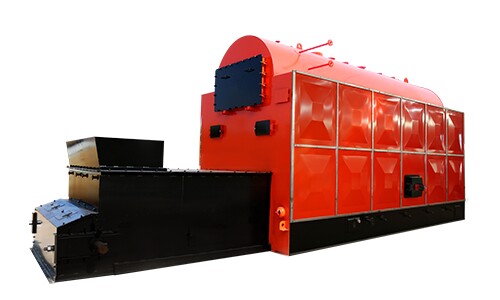
An electric boiler converts electricity to heat at a coefficient of performance (COP) of essentially 1.0: about 0.98–0.99 kWh of useful heat per kWh of electricity at the terminals. A modern gas-fired steam or hot water boiler delivers roughly 0.90–0.95 kWh of heat per kWh of gas (gross calorific value, GCV) once standby, blowdown and flue losses are counted. So the running-cost comparison reduces to one number: the ratio of your electricity price to your gas price per kWh. If electricity costs more than about 1.05–1.10 times gas per kWh, the gas boiler usually wins on energy cost alone. The interesting engineering is in the cases where that ratio is not the whole story.
The COP 1 baseline: what an electric boiler actually consumes
Resistance-heated electric boilers are close to 100% efficient at the point of conversion, but the system around them matters. Typical figures to use in a calculation:
- Element-to-water efficiency: 0.98–0.99.
- Standby and casing losses: 0.5–2% of rated output depending on insulation and cycling.
- Circulation pump and controls: 1–3% of boiler output for small hot water units; less for large steam units with variable-speed feed pumps.
- Blowdown (steam units): 1–5% of energy input depending on feedwater quality and blowdown rate.
A realistic system COP for an electric hot water boiler is therefore about 0.95–0.98, and for an electric steam boiler about 0.93–0.97. That is the number to put against gas.
Gas boiler efficiency: the number you must compare against
Gas condensing hot water boilers reach 0.95–0.98 (GCV) at low return temperatures (below about 50 °C), falling to 0.88–0.92 at higher returns. Industrial steam boilers typically run 0.85–0.93 (GCV) including blowdown and stack losses; economisers can add 3–5 points. Older fire-tube steam plant without an economiser often sits at 0.80–0.86. Use your actual measured stack temperature, O2/CO2 and blowdown rate, not the nameplate.
Electricity-to-gas price ratio: the decision number
Define R = electricity price (currency/kWh) ÷ gas price (currency/kWh), both on the same energy basis. The break-even ratio is R* = gas efficiency ÷ electric system efficiency. With a gas steam boiler at 0.90 and an electric steam boiler at 0.95, R* ≈ 0.95. In many markets R is 2.5–4.0, which is why electric boilers are rarely chosen for baseload heat. The table below shows the arithmetic with illustrative (not quoted) unit prices; substitute your own tariff.
| Case | System efficiency | Fuel input (kWh) | Assumed unit price | Annual energy cost (index) |
|---|---|---|---|---|
| Gas steam boiler, no economiser | 0.85 | 7,058,824 | 1.0 per kWh gas | 1.00 |
| Gas steam boiler + economiser | 0.91 | 6,593,407 | 1.0 per kWh gas | 0.93 |
| Electric steam boiler | 0.95 | 6,315,789 | 3.0 per kWh electricity | 2.68 |
| Electric hot water boiler | 0.97 | 6,185,567 | 3.0 per kWh electricity | 2.63 |
| Electric boiler, off-peak/surplus at 1.2 | 0.95 | 6,315,789 | 1.2 per kWh electricity | 1.07 |
Read the last row carefully: electric heat only competes when the delivered electricity price approaches the gas price per kWh. That is a tariff and utilisation question, not a boiler question.
Where electric actually wins
- Surplus or negative-price grid hours. If you can run during periods when wholesale power is very low or curtailed (wind/solar surplus, negative pricing), the effective R can fall below 1.0. This requires either a large thermal store or a process that tolerates intermittent heat.
- No flue, no gas connection. Electric boilers need no chimney, no gas main, no flue dilution fan and no CO/NOx flue path. In urban or listed buildings, or where a gas connection would require a long service run, the avoided infrastructure can dominate the business case.
- Permitting and emissions limits. Where local NOx limits or air-quality permits make gas firing expensive or slow to approve, electric removes the flue-gas permit path. Check your local rules; requirements vary by jurisdiction.
- Small loads and low utilisation. Below roughly 100–200 kW, gas fixed charges, flue costs and minimum turndown can outweigh the fuel-price gap. Electric also avoids gas standing charges.
- Redundancy and peak shaving. An electric boiler as backup or top-up avoids oversizing the gas plant and can cut gas capacity charges.
- Precise, fast control. Electric elements modulate in steps with no minimum firing rate and no purge losses, useful for tight temperature control.
Checklist before you compare quotes
- Record actual gas consumption and steam/hot water output for 12 months; compute real efficiency.
- Get the all-in electricity price including capacity charges, taxes and time-of-use bands.
- Get the all-in gas price including standing charges and any take-or-pay terms.
- Estimate annual full-load hours and load profile; identify hours that could shift to low-price periods.
- Size any thermal store needed to exploit off-peak or surplus power.
- Confirm electrical supply capacity (kVA) and whether a transformer upgrade is needed.
- Compare flue, gas connection, permit and floor-space costs on both sides.
- Check local emissions and permitting rules for both fuels.
For equipment options across electric and gas designs, see our product range, and for sizing method and cost drivers read the capacity and cost guide.
What to send us for a proposal
To size and cost an electric or gas boiler honestly, send: required steam or hot water output (kg/h or kW) and design pressure/temperature; annual heat demand and load profile (hourly if available); current fuel consumption and boiler efficiency data; available electrical supply (voltage, kVA, transformer headroom); space and flue constraints; water quality data (for blowdown and feedwater treatment); and your electricity and gas tariff structures including time-of-use bands. With those inputs we can model the annual energy cost at your real prices and show where electric wins and where it does not.


